architecture competition on the Reuse of an old coastal tower in Puglia (Torre Rinalda – Lecce)

Vision, view, observation are all synonyms common to the nature of Torre Rinalda.
The historical value of the building stems from its nature as a watchtower, a fortification that allowed control
over a vast portion of the territory.
From the outset, the project wanted to be linked to the nature of the architectural building to which it was linked, drawing inspiration directly from what was already present, proposing a second point of observation between the land and the sea.
However, in contrast to the massive and monolithic cha-racter of the Tower, the nature of the temporary Pavilion creates a link between two structures with a common conception but distinct in their temporal duration.
The Tower is the historical memory, present on the territory as a recognizable landmark; the Pavilion is a moment, a single episode that dialogues with the existing and gives it a new meaning.
The two architectures create a well-defined space between them which assumes the value of a place of aggregation and collection available to all and open to different types of use. The architecture of the pavilion itself is flexible and changeable based on the use and interaction of people, while the ruin of the tower houses a small contemplative and/or exhibition space.
The intervention on the existing one consists in the con-struction of a temporary scaffolding (also of the same nature as the Pavilion), aimed at creating a protected space at the top of the tower and allowing a view of the Apulian coast.
The materials chosen for the construction of the
Pavilion are simple and common, all following the idea of a structure that can be built in a short time and can be easily dismantled and transported.
The wooden panels can be connected to the main structure in different compositions, according to the different uses of the pavilion system.
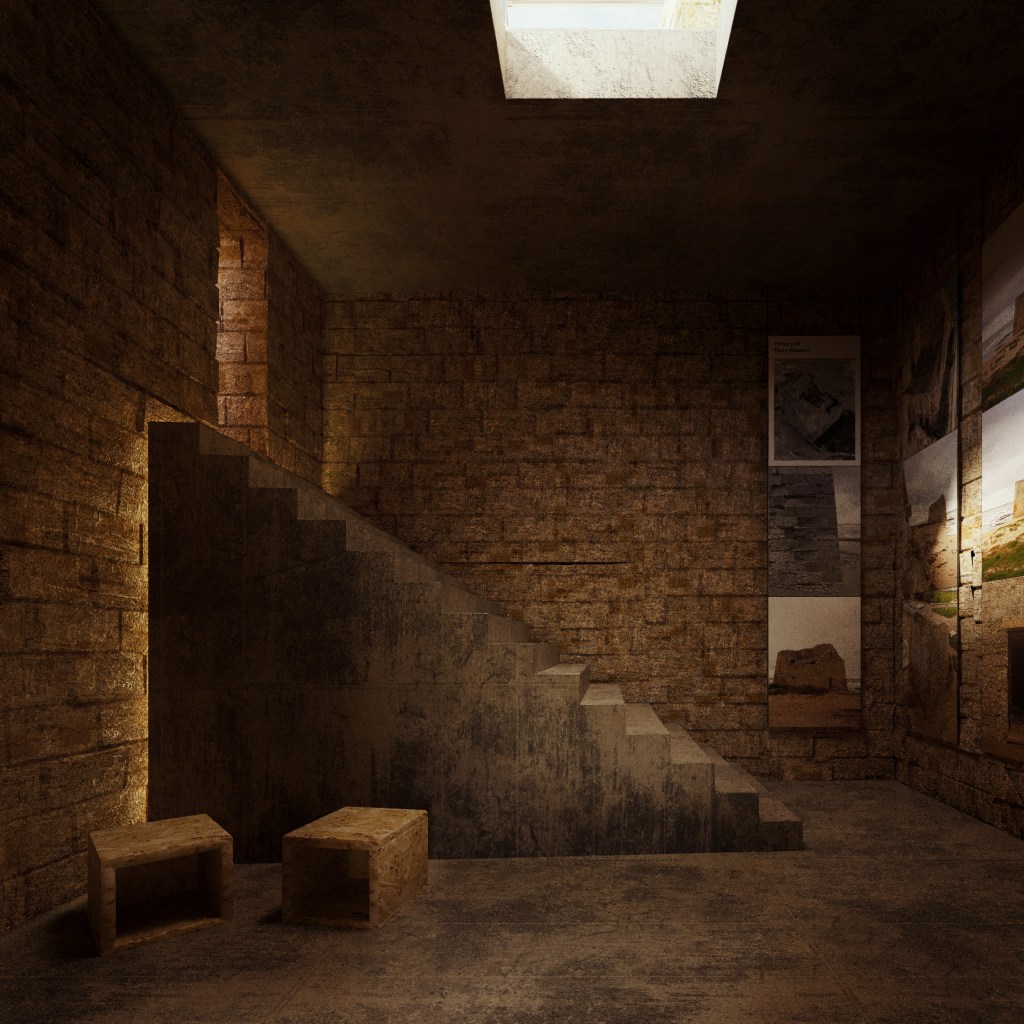
On the other hand, the only lasting intervention is the pre-sence of a pigmented concrete monolith which will be placed inside the space of the tower, as a sculptural element and a link between the two floors of the building.
The intervention therefore aims at the realization of an episode, a moment of enhancement of the present architecture, capable of giving new life to the historical ruins of the Tower.
 AR muRAtuRA Architecture & Visualization
Lascia un commento